Chalk
The porous rock absorbs and stores water. Its fine pores can make moisture available to the vine. This affects the root environment and water stress, including when a dry summer puts supplies under pressure.
Champagne is more than sparkling wine and more than a method of production. Behind every bottle is an origin shaped by climate, soils, slopes, grape varieties and people’s work.
The wine region is not one uniform area. Between Reims, Épernay and the Côte des Bar far to the south, the subsoil, exposure and climate change — and so do the growing conditions for the vines.
Champagne is a protected designation of origin. It brings together a delimited wine region and binding rules for cultivation and production. Within this single appellation are numerous winegrowing villages and individual parcels. Their natural conditions can differ markedly over even short distances.
Terroir describes this interplay: climate and subsoil, terrain and aspect, grape variety and human work. It also includes decisions in the vineyard and cellar. Origin provides a framework, not a predetermined flavour profile.
In the north, Reims, Épernay and three of the main winegrowing regions lie close together. The Côte des Bar lies considerably further south in the Aube. This geographical separation is part of Champagne’s diversity.
At around 49 degrees north, Champagne lies far north in traditional European winegrowing terms. Oceanic influences bring regular rainfall and moderate temperatures; continental influences bring greater contrasts, warm summer spells and a risk of frost. Young shoots are particularly vulnerable to late frosts.
The relatively cool conditions favour slow ripening and the retention of natural acidity. How well ripeness and freshness come together nevertheless depends on the vintage and each vineyard’s microclimate.
These conditions are not fixed: climate change brings earlier harvests and more extreme weather. A northerly location therefore guarantees neither permanently marginal ripeness nor protection from heat and drought.
Champagne thrives on a climatic balance: enough sunshine for ripeness, enough coolness for freshness.
Chalk is part of Champagne, but it does not explain the region on its own. Different sedimentary layers emerge at the edge of the Paris Basin. Limestone and marl, clay and sand, and their local combinations create very different conditions for vines.
The porous rock absorbs and stores water. Its fine pores can make moisture available to the vine. This affects the root environment and water stress, including when a dry summer puts supplies under pressure.
Limestone occurs in different formations. Marl combines calcareous and clay components. The Côte des Bar, with its limestone- and marl-rich subsoils, has a different geological character from the chalk slopes further north.
Clay can retain water and nutrients; sandy soils are often well aerated and free-draining. In the Marne Valley, these components alternate with other formations. What matters is always the soil profile of the particular parcel.
Subsoil affects water balance, warming, root development and ripening conditions — and thus the wine indirectly. An impression described as “mineral” is not the direct taste of the rock.
Champagne is a wine region of slopes. Gradient and aspect change when and how strongly sunlight reaches a parcel. Many vineyards face south, south-east or east; other exposures bring their own ripening conditions. Slopes also help excess water to drain away.
Altitude, hollows and the movement of cold air are also part of a site: cold air can collect in frost pockets. Woodland edges and proximity to a river can influence wind, moisture and temperature patterns. Their effect depends on the particular location.
Two vineyards with similar subsoil can therefore offer very different growing conditions. Together, aspect, altitude and microclimate give each vineyard its distinct identity.
Chardonnay, Pinot Noir and Meunier shape the wine region. Their distribution reflects growing conditions as well as experience and regional tradition. These are patterns of suitability and concentration, not rigid boundaries.
Particularly important in the Côte des Blancs, where chalk often lies close to the surface. Chardonnay also grows in other parts of Champagne.
Widely planted in the Montagne de Reims and Côte des Bar. Pinot Noir is also important in the eastern Marne Valley — under different natural conditions in each area.
Particularly important further west in the Marne Valley. Its later budbreak can reduce the risk from spring frost. It also suits certain cooler, more clay-rich sites; this does not make them frost-free.
Historically, “cru” here refers to a winegrowing village. Unlike the individual classified vineyards of Burgundy, for example, the village was the reference point for Champagne’s Échelle des Crus. Developed from 1911 onwards, the scale rated villages in percentages and originally served to differentiate grape prices.
Villages rated at 100 per cent formed the historical Grand Cru group; Premier Cru denotes the leading group below it. There are 17 historical Grand Cru villages. The scale itself was abolished in 2010, but the established designations may still be used under the appellation’s rules.
This is not a blanket classification of every piece of land within a village: the delimited vineyard areas and the origin of the grapes used for the wine are decisive.
Winegrowing in Champagne is documented from Gallo-Roman times. For many centuries, still wines were produced. Reims, as the coronation city of French kings, the Church and trade routes helped establish the region’s reputation.
Deliberate production of sparkling wines developed in the late 17th and early 18th centuries. Dom Pierre Pérignon was an important historical figure: his careful blending and cellar work formed part of a wider development that also included gentler pressing. A single “inventor of Champagne” cannot explain this shared, gradual development.
As success grew, so did the need to protect the wines’ origin. The legal delimitation of 1927 and recognition of the Champagne AOC in 1936 established the link between the name, its area and the rules of production.
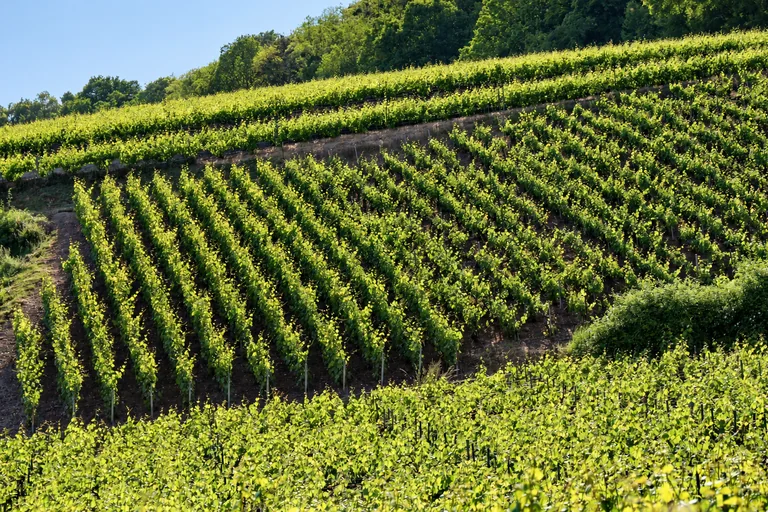
The Montagne de Reims stretches between Reims and Épernay. Its vineyards lie on the slopes of a wooded ridge, with aspects that vary considerably from village to village.
Discover Montagne de Reims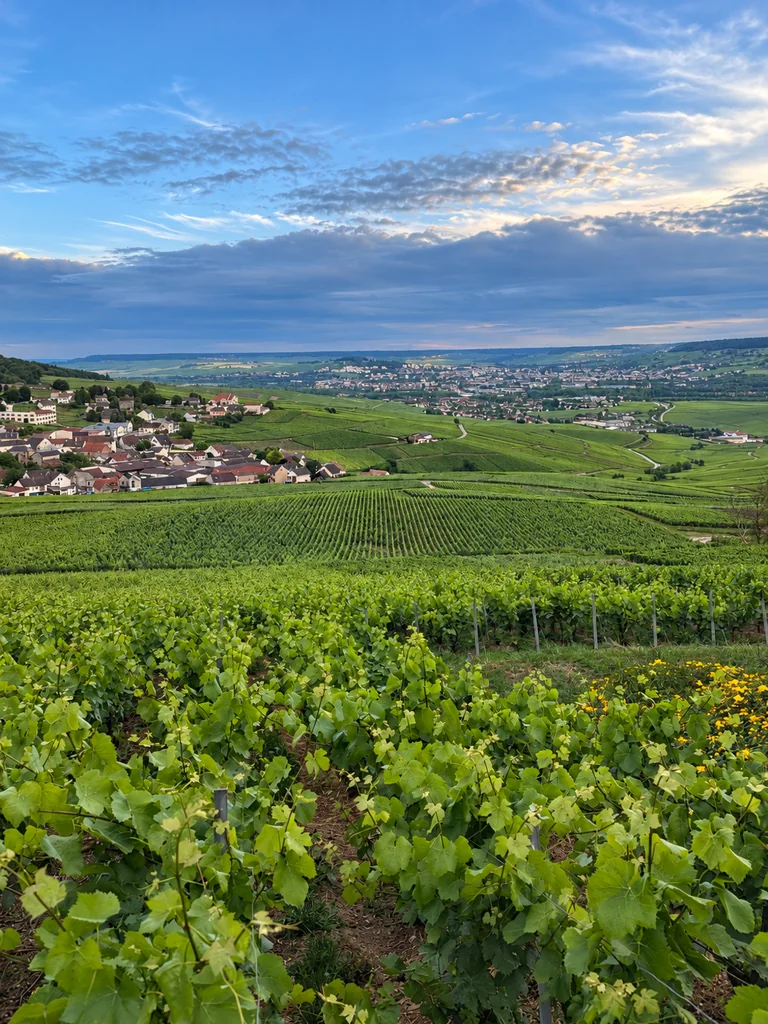
The Vallée de la Marne follows the River Marne west of Épernay. This extensive area encompasses different altitudes, aspects and local conditions.
Discover Vallée de la MarneCôte des Blancs
Chardonnay
The Côte des Blancs lies south of Épernay and is particularly closely associated with Chardonnay.
Discover Côte des BlancsCôte des Bar
Aube · Pinot Noir
The Côte des Bar lies in the south of Champagne, in the département of Aube. Geographically distinct from Reims and Épernay, it has its own landscape and geological identity.
Discover Côte des BarThe information is based on the Comité Champagne and INAO. The vineyard area is deliberately rounded. The map is our own schematic drawing for orientation; it does not show legally binding appellation or parcel boundaries.